

What is Skeleton Key?
An overview of what Skeleton Key does and how it fits together.
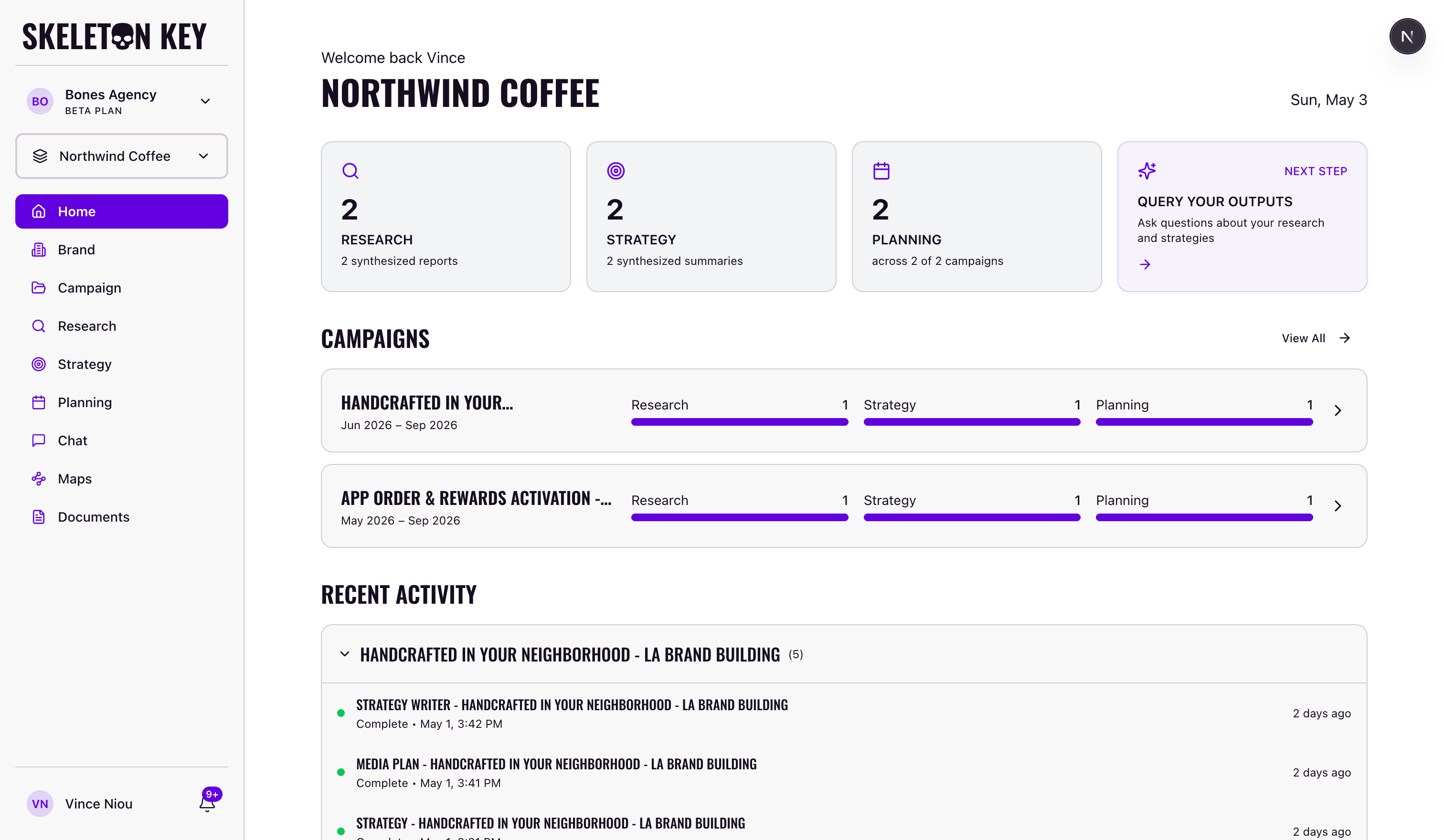
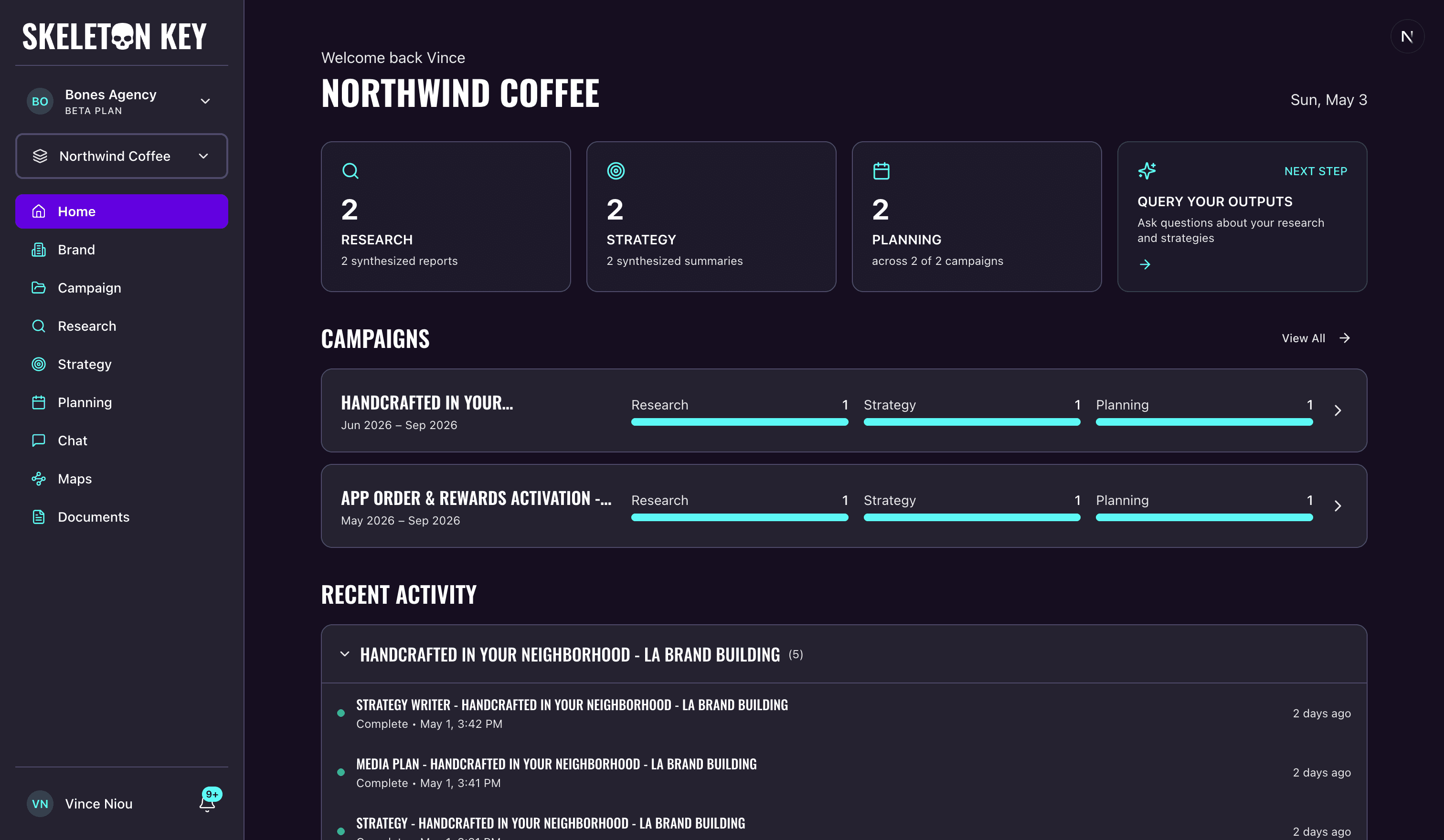
Skeleton Key is a marketing platform that uses coordinated AI agents to produce research, strategy, and media planning outputs from a brand brief and campaign objectives. It is for marketers and agency teams who need professional-grade marketing work done in minutes instead of weeks. The agents write citation-backed outputs; you review, refine, and direct them.
A research dossier, a four-part strategy, and a tactical media plan that would take days or weeks to produce manually take under 30 minutes end to end.
What it produces
Starting from brand details and a campaign brief, Skeleton Key generates four categories of output. A Brand Profile grounds every downstream workflow in your brand's voice, positioning, and competitive context. Five Research analysts cover different angles of the market, then synthesize into an executive one-pager and a long-form narrative report. A Strategy suite covers your objectives and key results, audience personas, communications direction, and media approach. A unified Strategy Summary caps the four strategist outputs. A Media Plan turns the strategy into a single tactical plan presented as three on-page sections: a plan overview, charts that visualize how budget is distributed, and seven detail tabs covering markets, flighting, channels, audiences, landing URLs (with auto-generated UTM tracking), goals, and pillars. Every output is citation-backed so you can trace what the agents used.
How the workflow flows
Five steps, run in order.
- Brand Profile: Provide your brand details once. The Brand Profiler agent enriches them with web research and, optionally, any documents you upload. Takes about 2-3 minutes.
- Campaign: Create a campaign brief inside the brand. A single brand can hold as many campaigns as you need.
- Research: Five analyst agents (Category, Competitor, Consumer, Culture, Social) cover different angles of market intelligence. About 3-4 minutes. You can optionally synthesize their findings into a one-pager and a narrative report (another 4-5 minutes).
- Strategy: Four strategists (Goals, Audience, Communication, Media) build on the research outputs, then a Strategy Summary unifies them into a single executive document. About 8-10 minutes for the strategists, plus another 2-3 for the summary.
- Media Plan: A unified plan rendered as three on-page sections: a plan overview, budget-distribution charts, and seven detail tabs (markets, flighting, channels, audiences, landing URLs, goals, pillars). URLs auto-generate UTM tracking per channel-tactic-format. About 6-8 minutes.
Research can be run at the brand level without a campaign. Strategy and Media Plan are always campaign-scoped.
Beyond the main workflow
Three supporting features sit alongside the five steps. Documents lets you upload PDFs, Word files, Markdown, CSVs, and Excel sheets as optional agent context. When you start a workflow, you can attach documents and the agents treat them as high-priority input alongside web research and upstream outputs. Smart Chat lets you query your outputs via embedded panels on the Brand, Research, Strategy, and Media Plan pages, or through the dedicated Chat page where you can pull outputs from multiple phases into a single conversation. Brand Maps synthesizes elements and relationships across phases into a node-and-edge graph linking entities and claims across outputs.
Who it's for
Skeleton Key is most useful for marketers and agency teams who have the context to evaluate and refine AI-generated outputs. That means someone who can look at a set of Goals and say "these don't fit our business model" or read a media strategy and push back on the channel mix. The platform is not a black box that generates finished work on autopilot. It is a structured workflow that handles the research volume and document assembly so you can spend your time on judgment calls. Smaller teams wearing many hats will get more out of it than large teams with dedicated research staff.
The product is in beta. Outputs are strong but not infallible, and you should validate citations and assumptions before briefing teams or committing budgets.
Where to go next
If you want to run through the full workflow end to end, the Quickstart walks you from brand setup to a finished media plan in 30 minutes. If you want to understand the underlying structure first (how orgs, brands, campaigns, and runs relate to each other), Core concepts covers that model before you start.
Last updated: 2026-05-04